
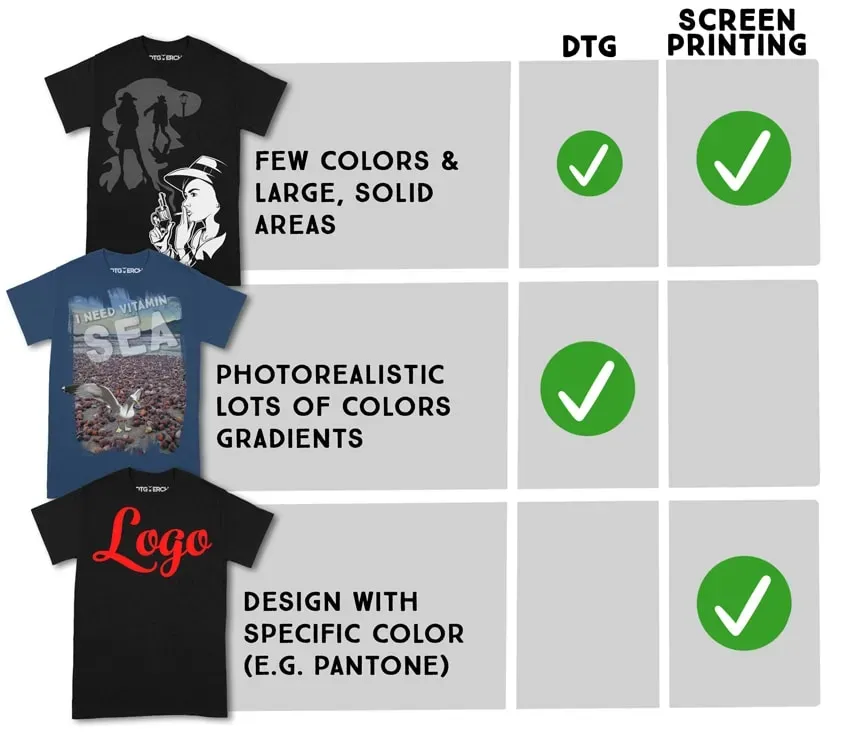
DTG vs Screen Printing is a common debate in apparel decoration, shaping cost, color vibrancy, and customer satisfaction for custom shirts. Understanding how direct-to-garment printing compares with traditional screen printing helps designers tailor designs to order size and fabric. DTG offers soft hand feel and intricate gradients, while screen printing delivers bold color coverage and proven print quality across fabrics. For small runs or designs with delicate shading, DTG shines as a flexible solution for rapid proofs and iterations. Choosing the right method for your brand means weighing color vibrancy, print quality, and the economics of custom shirts at scale.
In other terms, the comparison of digital garment printing and silk-screen methods highlights how producers balance design complexity with production efficiency. Digital garment printing enables high-resolution images and soft hand, while silk-screen approaches excel at bold color blocks and long runs. This lens helps brands plan inventory, manage costs, and deliver consistent print quality across ranges of fabrics. Ultimately, many shops adopt a hybrid strategy that leverages the strengths of both techniques to meet varied customer needs.
DTG vs Screen Printing: Choosing the Right Path for Your Custom Shirts
Choosing the right method for decorating custom shirts often comes down to scale, design complexity, and the fabric you’re using. The DTG vs Screen Printing decision hinges on what you value most: color fidelity, texture, and cost per unit across your order.
DTG and screen printing each bring distinct strengths. For designers handling intricate artwork, gradients, or photo-like images on cotton-heavy tees, DTG offers soft hand feel and precise detail. For large runs of bold graphics or simple colors on a wide range of fabrics, screen printing delivers consistent color saturation and strong durability.
When to Use Direct-to-Garment Printing for Custom Shirts
Direct-to-garment printing shines in small to mid-size runs, where setup time matters less and design complexity can flourish. When your custom shirts feature many colors, soft gradients, or photographic imagery, DTG can reproduce subtle shading without the color-separation steps required by screens. It’s particularly effective on light fabrics with cotton-rich blends.
On dark fabrics, pre-treatment steps are essential for DTG, adding a step in the workflow but enabling bright print quality. With minimal per-shirt setup costs, DTG is ideal for proofs, limited editions, and on-demand drops in the direct-to-garment space.
Color Vibrancy and Print Quality: DTG vs Screen Printing Compared
Color vibrancy is a core difference between these methods. DTG excels at reproducing gradients and photorealistic detail, producing smooth color transitions on white or light shirts. Screen printing, meanwhile, delivers bold, saturated color and reliable print quality on a wide variety of fabrics, especially for simple or bold designs.
Texture and feel also influence perception. DTG tends to be softer, integrating with the fabric for easy wear, while screen prints can feel slightly raised with dense ink layers. Understanding how each method communicates the artwork helps align customer expectations and the overall look of custom shirts.
Fabric and Substrate Considerations for Custom Shirts with DTG and Screen Printing
Fabric matters: DTG performs best on 100% cotton or high-cotton blends, with pre-treatment for dark fabrics to achieve brightness. Polyester-rich fabrics pose more challenges for DTG due to dye migration, though advances in inks are narrowing the gap.
Screen printing is versatile across fabrics and offers strong color fidelity across a wide range of substrates when ink chemistry and curing are optimized. It remains robust for cotton, poly blends, and even some synthetics, making it a go-to for diverse custom shirts.
Cost, Lead Time, and Production Scale for Custom Shirts: A Practical Guide
Cost and production scale are often the deciding factors. For very small runs, DTG’s low setup cost can be more economical, while large quantities typically benefit from screen printing’s economies of scale. Per-unit costs drop as volume increases, with screen printing delivering lower prices for thousands of units.
Lead times and proofs should also influence the choice. DTG allows rapid proofs and flexible on-demand testing, while screen printing requires more setup but can deliver fast production once the screens are prepared. This makes planning essential for meeting customer timelines and inventory goals.
Hybrid Strategies for Brands: Leveraging DTG and Screen Printing for Maximum Impact
A hybrid approach often yields the best outcomes for brands. Use DTG for limited editions, color gradients, and detailed artwork on custom shirts, while relying on screen printing for high-volume staples and bold graphics with strong color vibrancy.
Coordinating workflows, color management, and quality control with trusted print partners helps ensure consistent print quality. Testing on representative garments, evaluating ink density and edge crispness, and ensuring proper curing are key steps in a successful hybrid strategy for custom shirts.
Frequently Asked Questions
DTG vs Screen Printing: Which is best for custom shirts with many colors and smooth gradients?
DTG vs Screen Printing: Direct-to-garment printing excels at color fidelity and subtle gradients for custom shirts, often with a soft hand feel. Screen printing delivers strong color vibrancy and cost efficiency for large runs. For designs with photo-like detail, DTG is typically preferred; for high-volume, bold artwork, screen printing tends to be more economical.
DTG vs Screen Printing: What factors should I consider for custom shirts when choosing between direct-to-garment printing and screen printing?
Key factors include order size, design complexity, color vibrancy requirements, fabric type, and budget. DTG is favorable for small to mid runs with multicolor or gradient artwork, while screen printing shines on large quantities with durable, vibrant colors across a wide range of fabrics. Consider lead times, print quality expectations, and long-term costs.
DTG vs Screen Printing: Which method delivers better color vibrancy and print quality for custom shirts with photos?
DTG offers excellent print quality for detailed, photo-quality designs with smooth gradients. Screen printing delivers highly saturated color vibrancy, especially on light fabrics, and can achieve crisp edges with strong durability. For photographic artwork, DTG often provides superior detail; for bold, high-visibility images, screen printing can be more impactful.
DTG vs Screen Printing: Which method offers greater durability for custom shirts that go through frequent wash cycles?
Screen printing generally provides greater durability and color retention under repeated washing when properly cured. DTG can also be durable on cotton-based fabrics with correct pre-treatment and curing, but long-term performance can vary with fabric, care, and ink chemistry. For sportswear or heavy-use apparel, screen printing is typically the safer choice for longevity.
DTG vs Screen Printing: How do turnaround times and setup differ for custom shirts?
DTG typically offers faster setup for small orders and quick proofs due to minimal color separations. Screen printing requires more upfront setup (screens for each color), which can slow initial production but becomes highly efficient at scale. For rapid testing and limited editions, DTG is advantageous; for large campaigns, screen printing often yields faster batch production.
DTG vs Screen Printing: Can I combine the two methods (hybrid approach) to optimize print quality for custom shirts?
Yes, a hybrid strategy can optimize color vibrancy and print quality. Use DTG for detailed artwork and color gradients, and reserve screen printing for bold, high-volume logos or simple graphics. Plan with test prints and aligned workflows to ensure consistent results across both methods.
| Topic | DTG | Screen Printing |
|---|---|---|
| What are DTG and Screen Printing? | DTG stands for direct-to-garment printing; sprays water-based inks directly onto fabric, often with a pre-treatment step for dark fabrics; excels at gradients and photorealistic images with a soft hand feel. | Screen printing pushes ink through woven screens onto fabric; each color is typically produced with its own screen; highly efficient for large volumes with strong color fidelity across many fabrics. |
| When to Choose DTG | Best for small-to-mid runs; many colors; smooth color transitions and photo-like imagery; vibrant on light fabrics; works well with cotton-heavy blends; fast setup and low per-shirt setup costs. | Best for large runs; dense ink coverage; lower per-unit cost at scale; strong color vibrancy and durability across fabrics; wide compatibility with fabrics and sizes; efficient for simple or bold designs with limited colors. |
| Color, Texture, and Print Quality | DTG excels at rendering gradients and fine details; prints have a soft, integrated feel with minimal color separation work. | Screen printing delivers bold, saturated colors and strong color vibrancy; prints can have a slightly raised texture, especially with dense ink; great on light backgrounds. |
| Fabric and Substrate Considerations | DTG works best on 100% cotton or high-cotton blends; dark fabrics require pre-treatment; dye migration can be an issue on poly blends, though advances are narrowing gaps. | Screen printing is versatile across fabrics (cotton, blends, and some synthetics) with proper ink chemistry and curing; polyester can be more challenging. |
| Cost, Time, and Production Scale | Low setup for very small runs; fast proofs; per-shirt cost not minimized at scale. | Upfront setup for screens; per-unit cost drops with higher volumes; slower setup but faster production once established for large batches. |
| Lead Time and Workflow Considerations | Digital design with a single print pass; rapid proofs; ideal for on-demand or limited editions. | Screens must be created/aligned for each color; more complex workflow; lead times increase with setup but become efficient at high volumes. |
| Durability and Washability | DTG inks provide good durability but depend on fabric, washing conditions, and pre-treatment quality. | Screen printing inks offer excellent color retention and wash resistance when properly cured; often more durable for heavy use. |
| Practical Use Cases | Small runs with intricate designs; on-demand or limited editions; cotton-heavy fabrics; soft hand feel. | Large campaigns and merch drops; bold graphics on a broad range of fabrics; high-volume staples; simple or vivid designs. |
| Choosing the Right Method for Your Brand | DTG is strong for small collections needing high-fidelity images and fast proofs. | Screen printing shines for mass-market apparel, long-term inventory, and high-volume orders; often a hybrid approach works best. |
| Quality Control and Vetting Partners | Ask printers about ink systems, curing temperatures, fabric compatibility; request test prints; check pre-treatment quality and wash results. | Review ink density, registration accuracy, and post-cure soft hand; request test prints and color matching checks. |
| Maintenance and Longevity of Equipment | DTG printers require ink management, nozzle maintenance, and proper curing. | Screen printing equipment requires screen cleaning, emulsion removal, tension checks, and consistent squeegee pressure. |
Summary
DTG vs Screen Printing presents two primary methods for decorating custom shirts, each with unique strengths. For small-batch production, DTG offers high fidelity images, soft hand feel, and fast proofs; for high-volume production, Screen Printing delivers lower per-unit costs and durable results across a wide fabric range. A practical approach often combines both methods: use DTG for limited editions or designs with heavy color gradients, and rely on Screen Printing for large-scale staples and bold graphics to maximize efficiency and consistency.